
Blended Safety Training
The Complete Training & Certification Method for Delivering Fully Compliant & Scalable Workplace Safety Training
Table of Contents
Introduction
Think you need to send workers off-site to distant training centers or hire expensive safety consultants who shut down your entire operation for full-day classroom safety training sessions.
Think again.
Using the right training method, you can deliver all your safety training in-house, on your schedule, using your own people.
This method also ensures full compliance with OSHA, ANSI, NFPA, CSA, DOT, and other applicable safety standards, depending on the training topic.
The method is “Blended Training.”
Blended training isn’t new. But it’s often misunderstood — or ignored entirely because employers assume they need outside help to train their workforce.
They don’t.
This guide explains what blended safety training is, which training topics require it, which can be completed entirely online, and how to implement it across your organization.
Before getting into blended safety training, let’s quickly review the typical structure for safety training based on regulations and consensus standards.
Safety Training Requirements
Many workplace safety training topics share a common structure. Whether you’re training heavy equipment operators, electrical workers, or employees who work at heights, the regulatory requirements often include two distinct components:
General Training
This is the theory and fundamentals portion, commonly viewed as the “classroom” component. It covers hazard recognition, safe work practices, regulatory requirements, and the foundational knowledge workers need before they ever touch equipment or encounter hazards on the job.
Workplace-Specific Training
This is the practical portion, which is completed at your facility, using your actual equipment, covering your specific hazards and procedures. It connects the general knowledge to the real environment where workers will apply it.
Evaluations
Both components conclude with an evaluation to confirm a worker’s competence. General training concludes with a knowledge assessment such as a quiz, test, or exam that verifies the worker understood the material. Workplace-specific training concludes with a practical evaluation that observes the workers and confirms they can apply what they learned safely and correctly.
The Complete Training Process
For most hands-on safety training topics, the full process looks like this:
- General Training: Covers theory, hazard recognition, and safe work practices. Can be completed in a classroom or online.
- Knowledge Evaluation: Verifies the worker understood the material. Can be administered in a classroom or automatically through online training.
- Workplace-Specific Training: Completed at your facility using your actual equipment, covering your specific hazards and procedures.
- Practical Evaluation: A qualified trainer or evaluator observes the worker performing tasks, confirms they’re performed safely, and documents the results.
All components are essential. Skipping any one of them fails to meet regulatory requirements, and worse, it could result in workers getting injured or killed.
The Two Common Mistakes
Some employers focus on the theory portion but stop there. They have their workers complete a classroom session or online training, and everyone assumes they’re “fully trained.” But they’ve never connected that knowledge to the actual tasks and hazards in their workplace.
Others go the opposite direction.
Workers learn on the job and are shown the ropes by a supervisor or experienced coworker, but they don’t receive the required safety training or a documented evaluation. They know how to perform the tasks, but they’ve missed the critical safety content covered in proper training.
The “theory-only worker” has knowledge but struggles to apply it to their specific workplace.
The “practical-only worker” knows the job but lacks the hazard recognition and safety principles that could save their life.
Compliance requires all components. Effective training requires all components.
This is where blended safety training comes in.
What is Blended Safety Training?
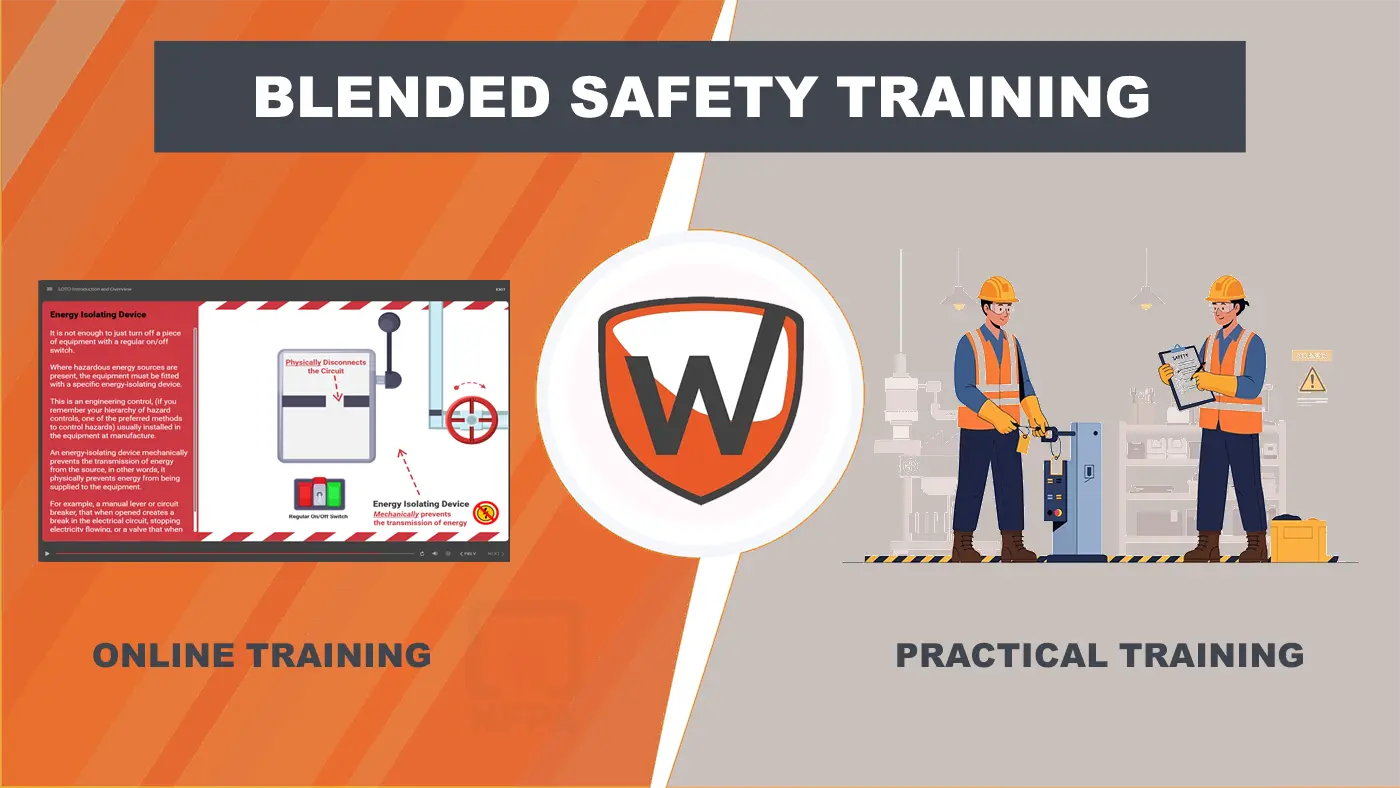
Blended training is exactly what it sounds like: a combination of two training methods working together.
Method 1: Online Training
The general safety training is delivered online. Workers complete it independently, at their own pace. This covers the theory, fundamentals, hazard recognition, regulatory requirements, and safe work practices that apply regardless of where someone works.
Method 2: Workplace-Specific Training
The practical, workplace-specific training is delivered in person, at your facility, by someone from your team. This covers your equipment, your procedures, and the specific hazards your workers will actually encounter.
Combining the Two Methods
Each method excels in its own area. Online training delivers consistent, comprehensive safety content without requiring workers to spend hours in a classroom. In-person training connects that knowledge to the real environment where workers will apply it.
Together, they form a complete training program that meets regulatory requirements and actually prepares workers for the job.
Which Safety Topics Require Practical Training?
As we mentioned earlier, not all safety training is theory only and can be completed in a classroom or via online training on its own. Many topics require a practical component that can include hands-on demonstration, practical evaluation, or workplace-specific instruction that simply can’t happen through a screen or in a classroom.
Some common training topics that require a workplace–specific, practical component include the following:
Equipment Operator Training
Any training that involves operating equipment requires hands-on evaluation. Workers need to demonstrate they can safely operate the actual equipment they’ll use on the job.
Examples include:
- Forklift and powered industrial truck training
- Aerial lift and MEWP training
- Overhead crane training
- Telehandler training
- Pallet jack training
For these topics, online training covers the theory: stability principles, load handling, hazard recognition, pre-operation inspections, and safe operating procedures. The workplace-specific portion includes hands-on operation and a practical evaluation on your actual equipment.
Electrical Safety & Lockout/Tagout Training
Energy control safety training, including electrical safety, arc flash, and lockout/tagout requires workers to understand your specific equipment, procedures, and safeguards.
Examples include:
- Electrical safety training
- Arc flash safety training (NFPA 70E / CSA Z462)
- OSHA lockout/tagout training
Online training covers the fundamentals: hazard recognition, risk assessment, PPE selection, and safe work practices. The workplace-specific portion covers your equipment, your energy control procedures, and your lockout/tagout devices.
Fall Protection Training
Fall protection training requires workers to understand the specific fall hazards at your site and demonstrate competency with the equipment they’ll use.
Online training covers fall hazard recognition, protection methods, equipment types, and inspection requirements. The workplace-specific portion covers your site’s fall hazards, anchor points, and hands-on practice with your fall protection equipment.
All Other Hands-On Training Topics
The above are just a few of the training topics that must include some type of practical component in your workplace. Any safety training that has hands-on requirements will require a practical component to meet regulatory requirements and ensure your workers have the correct skills to keep themselves safe.
Online Training vs. Classroom Training
Traditionally, the theory and fundamentals portion of safety training was delivered in a classroom. An instructor, a room full of workers, a full day or even several days away from the job.
It can work, but it’s not without its problems.
You have to coordinate schedules. Pull workers off the floor at the same time. Pay for an instructor or send people to an off-site training center. And if you hire someone new next month, you’ll either be waiting for the next scheduled session or running a class for just one person.
Online training delivers the same content without the logistical headaches.
Workers complete it when it makes the most sense for your schedule. No travel. No waiting for a class to fill up. Someone hired today can start training today. Someone who needs a refresher can complete it without coordinating anyone else’s schedule.
The content doesn’t change. What changes is that the delivery is more flexible, more scalable, and significantly less disruptive to your operation.
And because online training includes built-in knowledge evaluations such as quizzes, exams, pass/fail tracking, you get documentation that the worker actually engaged with the material. That’s harder to prove with a classroom session where someone may have been in the room but mentally checked out.
Online training isn’t a shortcut. It’s a more efficient way to deliver the classroom component of safety training without sacrificing content or documentation.
Traditional Classroom |
Online Training |
|
| Scheduling & Availability | Fixed dates. Difficult to coordinate across shifts and locations. | Workers train anytime. No scheduling conflicts. |
| Speed to Train New Hires | Must wait for the next available class. Delays onboarding. | Train the same day they’re hired. No delays. |
| Impact on Operations | Pulls crews off the floor for full-day sessions. Operational disruption. | Training takes place when most convenient. No need to shut down. |
| Consistency & Quality of Training | Varies by instructor, delivery style, and time constraints. | Same content, same quality, every worker, every time. |
| Instructor Dependence | Must have a qualified instructor available for every session. | Training runs automatically. Trainers only handle the practical. |
| Knowledge Verification | Manual grading. Inconsistent verification. | Automated built-in quizzes, scoring, and pass/fail tracking. |
| Documentation | Spreadsheets, paper sign-ins, inconsistent records. | Certificates and records stored automatically and audit-ready. |
| Scalability Across Locations & Shifts | Difficult. More workers = more classes, more instructor time. | Easy. Train 5 or 5000 with the same effort. Scales instantly. |
| Administrative Time Required | Hours spent scheduling, coordinating, documenting, | Minimal administration, saving hundreds of hours. |
| Compliance Confidence | Harder to prove what was taught or whether workers understood it. | Documented content, evaluations, and timestamps provide clear defensibility. |
| Cost | High. Instructor fees, room rental, travel, time off the job. | Fraction of the cost. No live instructor-time losses. |
| Flexibility for Workers | Incompatible pace for many workers. | Workers train at their own pace, revisit lessons, and complete when convenient. |
Who Can Deliver Workplace-Specific Training?
Most regulations and consensus standards indicate that a person must be “competent” to deliver the workplace-specific training and evaluate workers during the practical safety training component.
This might seem confusing at first, but it’s actually great news because this doesn’t require hiring outside consultants. In most cases, you already have people in your company who either already have the knowledge, skills, and experience to be considered competent, or who quickly get there with some additional training.
Here are some examples of who can fill the role of internal trainer and evaluator for many, if not most safety training topics.
Supervisors, Leads, and Managers
Supervisors usually have in-depth knowledge of your facility’s equipment, hazards, and procedures. With their experience and authority, they’re well-positioned to train workers on site-specific safety guidelines, policies, and procedures, and evaluate competency.
By enhancing their fundamental safety knowledge and teaching abilities through additional training, they can better communicate safety guidelines and evaluation criteria to workers.
Experienced Workers
Senior employees who are familiar with the hazards in the workplace, specific safety guidelines, and have hands-on experience with the equipment make strong candidates. They know the real-world challenges workers will face.
These experienced workers can also be highly respected and have long-standing rapport with your workforce, which has an additional benefit of improving your company’s safety culture.
Completing a train-the-trainer program can help them add instructional skills and turn their real-world expertise into actionable teaching skills for workers. This ensures that training is both practical and highly relevant to the work environment.
Safety Managers
Safety managers understand workplace safety standards and can integrate training into your overall safety program. They’re well-suited to deliver training that’s both practical and compliant.
With additional tools to refine their instructional approach, safety managers can provide workers with a robust and compliant training experience.
Choosing the Right Trainer
The best trainers are individuals who already have an in-depth understanding of your workplace, equipment, and hazards.
Supervisors, experienced workers, and safety professionals within your organization can leverage their existing knowledge to become highly effective trainers.
With the right preparation, they can deliver workplace-specific training and conduct evaluations that meet regulatory requirements, without the need to hire outside consultants.
Safety Train-the-Trainer Programs
Your supervisors, experienced workers, and safety professionals bring valuable workplace knowledge to the table.
But there’s a distinction between understanding your facility and knowing how to teach others effectively.
A train-the-trainer program bridges that gap.
It helps your internal trainers incorporate instructional techniques, evaluation methods, and a structured approach to delivering workplace-specific training, enabling them to train your team with confidence and consistency.
Benefits of Safety Train-the-Trainer Programs
- Strengthens Knowledge and Instructional Skills: Deepens understanding of the training topic and provides practical teaching techniques.
- Ensures Compliance: Trained instructors deliver consistent training that meets regulatory requirements and know how to document it properly.
- Enhances Evaluation Skills: Teaches trainers how to assess worker competency through practical demonstrations and provide constructive feedback.
- Builds Long-Term Internal Capability: Once qualified, that capability stays with your organization. New hires, refreshers, procedure updates. You handle the entire training program internally without scheduling outside consultants or waiting for the next available session.
- Saves Time and Resources: Developing in-house trainers and evaluators eliminates the need for costly external training providers. By empowering internal staff, businesses can streamline their training programs and reduce downtime.
One Trainer, Multiple Topics
Many train-the-trainer programs cover specific topics such as forklift, aerial lift, arc flash, fall protection, and lockout/tagout.
But the instructional skills transfer. Once someone has experience delivering one type of training, they’re better equipped to deliver others. Building internal training capability is an investment that pays off across your entire safety program.
Why Blended Safety Training Works
Here’s why blended training has become the preferred method for organizations that want to keep workers safe, ensure compliance, and save time and money.
Full Regulatory Compliance: Blended training covers all required components including theory, knowledge evaluation, workplace-specific instruction, and practical demonstration where required. You’re not just checking some of the boxes. You’re checking all of them.
Reduced Risk of Incidents: Workers who complete all required training components are better prepared to recognize hazards and work safely. They understand the principles and know how to apply them in their specific work environment.
Complete Control Over Your Training Program: You decide who trains, when training happens, and how it’s delivered. No coordinating with outside vendors. No waiting for scheduled sessions. Your team, your schedule, your facility.
Lower Training Costs: Online safety training costs a fraction of the cost of instructor-led classroom sessions. Your internal trainers handle the workplace-specific portion and practical evaluation. This means no consultant fees, no per-worker charges for the hands-on component. When you factor in the quantified time savings for administration, the cost savings are even more substantial.
Scalable for Any Team Size: Whether you’re training five workers or 5000, the process is the same. Online training scales infinitely. Your internal trainer handles the practical portion regardless of group size. Growth doesn’t mean multiplying your training costs for workplace-specific training.
Minimal Disruption to Operations: Workers complete online training at a time that’s most convenient for your operations, including between shifts, during breakdowns, or during scheduled downtime. The workplace-specific portion can also be scheduled at a time that is most convenient and flexible.
Long-Term Internal Capability: Once your trainers are qualified, that capability stays with your organization permanently. New hires, refreshers, procedure updates. You handle it all without outside help. You build the system once and use it indefinitely.
How to Implement Blended Safety Training
Here’s how the complete blended safety training method works step by step, through WorkplaceSafety.com:
Step 1: Identify Which Topics Need Blended Training
Review your training requirements and determine which topics require hands-on demonstration or workplace-specific practical training (blended).
Step 2: Designate Your Internal Trainers
Identify who will deliver the workplace-specific training for each topic. This could be the same person across multiple topics or different trainers based on expertise.
Step 3: Enroll Internal Trainers in Safety Train-the-Trainer Programs
Enroll your designated trainers in the appropriate train-the-trainer programs. They’ll complete the training and be prepared to deliver the workplace-specific portion and evaluate worker competency.
Step 4: Enroll Workers in Online Training
Purchase online training registrations for your workers. They complete the theory and fundamentals portion at their own pace, complete the knowledge evaluation, and receive their certificate of completion.
Step 5: Deliver Workplace-Specific Training
Your qualified trainers conduct the practical training at your facility, covering your specific equipment, hazards, and procedures. They evaluate worker competency and document completion.
Ongoing Blended Safety Training
Once your trainers are qualified and the initial setup is complete, ongoing blended safety training is simple.
- Onboarding New Hires: New workers complete the online safety training, then your trainer delivers the workplace-specific portion and evaluates their competence. Same process, no additional setup required.
- Refresher Training: When it’s time for refresher training, whether annually, every three years, or when a worker is observed to be performing unsafely, the process is the same: Workers complete the online training, and your trainer handles the practical portion.
- Qualifying Additional Trainers: As your team grows or trainers move on, you may need to qualify additional safety instructors. Simply purchase additional trainer registrations and enroll them in the program. Once they complete it, they’re ready to train.
Purchasing Additional Registrations
Additional employee online safety and train-the-trainer registrations can be purchased at any time.
With WorkplaceSafety.com, safety training registrations never expire. You can purchase in higher quantities to take advantage of volume discounts without worrying about losing them.
They remain in your account until you’re ready to use them—for new trainers, onboarding, or refresher training.
Frequently Asked Questions
Is blended training compliant with OSHA and other safety standards?
Yes. Blended safety training is one of the most compliant methods available because it includes all required components: theory, knowledge evaluation, workplace-specific training, and practical demonstration where required. Many training approaches skip or shortcut one of these components. Blended training covers them all by design.
Is online safety training recognized by OSHA?
Yes. OSHA recognizes online training for the knowledge-based components of safety training. For topics that require hands-on demonstration or practical evaluation, online training must be supplemented with in-person instruction, which is exactly what blended training provides.
How quickly can we implement blended training?
The blended safety training method can be implemented as quickly as the same day.
The train-the-trainer programs can take between 3 – 6 hours to complete, and workers can begin their online safety training simultaneously.
Once both are done, your trainer can deliver the workplace-specific portion immediately. Some organizations are fully up and running within 24 hours. Others spread it across a few days or weeks, depending on their schedule. The timeline is entirely up to you.
What if our trainer leaves the company?
If your qualified safety trainer leaves the company, you can designate another employee as a trainer, have them complete the train-the-trainer programs, and have them take over. Using a blended approach with internal trainers helps you eliminate or minimize disruptions to your safety training programs.
Most employers will qualify more than one safety trainer from the start for backup coverage and flexibility across different shifts and locations, as well as to cover for trainers who leave the company.
Can one trainer cover multiple safety topics?
Yes. Many organizations have a single trainer or small team that handles multiple topics. The instructional skills can transfer, and there are various train-the-trainer programs that can help prepare them for each specific topic.
Why is blended safety training more effective than just sending workers to an offsite class?
Here’s what many employers don’t realize: even if you send workers to an off-site training center, you still have to complete the workplace-specific portion yourself. The offsite class can’t train workers on your equipment, your hazards, or your procedures. They’ve never seen your facility. That part is still on you.
So the perceived benefit of offsite training (”I just send them somewhere, and it’s done”) isn’t actually true. You’re paying for travel, time off the job, and instructor fees, and you still have to complete the workplace-specific training when they return.
The blended safety training method acknowledges this reality from the start. Online training handles the theory component more efficiently and at a fraction of the cost. Then your internal trainer delivers the workplace-specific portion, which you’d have to do anyway.
Better outcome, less money, less disruption.
Is training available in Spanish?
Yes. Our safety training courses and train-the-trainer programs are available in both English and Spanish.