
OSHA’s Top 10 Most Cited Standards for 2026: 5 Training Checks for Employers
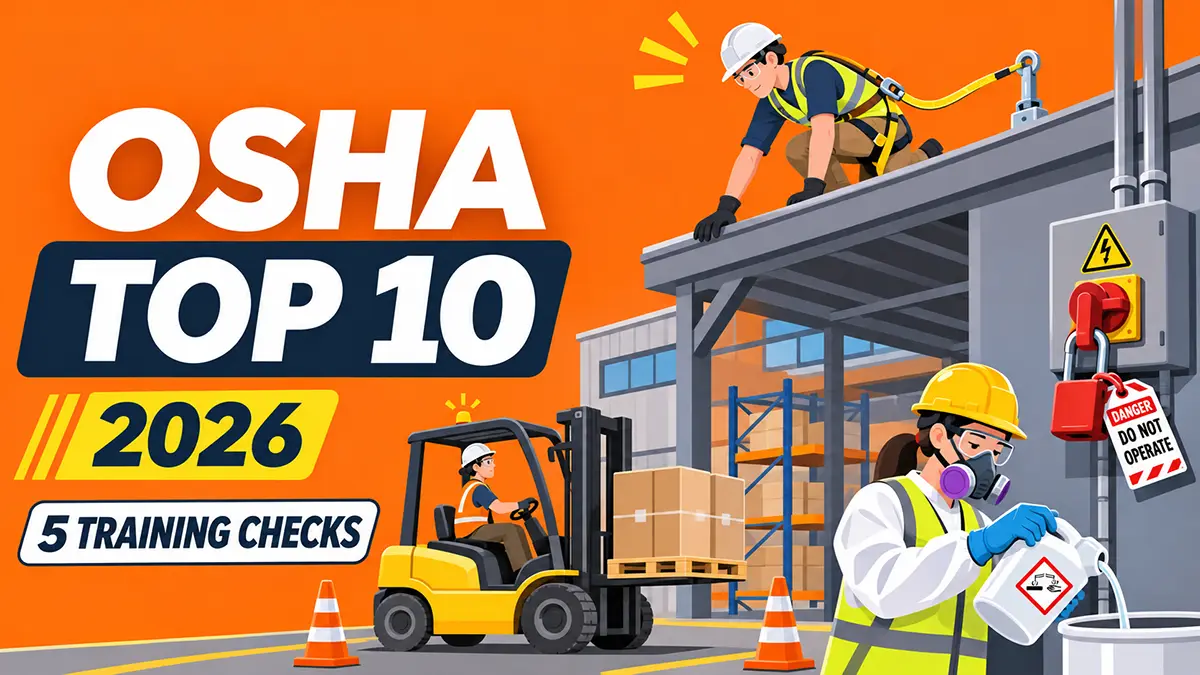
OSHA’s top 10 most cited standards for fiscal year 2026 are out, and the list looks familiar. Fall Protection, General Requirements ranks first for the 16th year in a row, and the same 10 standards made the list again, with some changes in ranking.
These are hazards employers deal with every day. Hazardous chemicals, energized equipment, forklifts, respirators, and work at heights. Several of these standards include specific training, evaluation, and documentation requirements, which makes the list a practical starting point for reviewing your own training program.
Key Takeaways
- Fall Protection, General Requirements (1926.501) topped the preliminary list for the 16th consecutive year with 4,041 violations.
- Four of the 10 standards address fall hazards, accounting for 8,698 violations combined.
- Hazard Communication, Lockout/Tagout, Powered Industrial Trucks, Fall Protection Training, and Respiratory Protection all include training requirements you can check at your workplace right now.
- Online training covers general instruction. Workplace-specific instruction, practical training, and evaluations remain the employer’s responsibility.
OSHA’s Top 10 for FY 2026 (Preliminary)
OSHA announced the preliminary results on September 15, 2026, at the National Safety Council’s Safety Congress & Expo. The data covers federal OSHA inspections across all industries from October 1, 2025, through August 31, 2026. Because the data is preliminary, counts and rankings may change when OSHA publishes final numbers.
| Rank | Standard | Standard Number | Preliminary Violations |
| 1 | Fall Protection, General Requirements | 1926.501 | 4,041 |
| 2 | Hazard Communication | 1910.1200 | 1,961 |
| 3 | Lockout/Tagout | 1910.147 | 1,863 |
| 4 | Scaffolding | 1926.451 | 1,725 |
| 5 | Ladders | 1926.1053 | 1,659 |
| 6 | Respiratory Protection | 1910.134 | 1,608 |
| 7 | Powered Industrial Trucks | 1910.178 | 1,379 |
| 8 | Fall Protection, Training Requirements | 1926.503 | 1,273 |
| 9 | Eye and Face Protection | 1926.102 | 1,120 |
| 10 | Machine Guarding | 1910.212 | 1,072 |
Sources: OSHA’s preliminary Top 10 and the National Safety Council announcement. Hazard Communication is shown with its standard number, 1910.1200.
Which Training Requirements Should You Review?
The Top 10 includes both construction (1926) and general industry (1910) standards. Start with the standards that apply to your operation.
The five checks below cover specific training requirements within five of the listed standards. They’re a practical place to start, not a ranking of the individual subsections OSHA cited in 2026.
1. Hazard Communication: 1910.1200(e), (g), and (h)
The Hazard Communication standard requires a written program, safety data sheets, labels, and employee training. Employees must be trained when they’re first assigned to work with hazardous chemicals, and again whenever a new chemical hazard they haven’t been trained on is introduced into their work area.
What to check: Pick a chemical used on a current shift. Ask the employees using it to find its safety data sheet, explain the label, and describe how they protect themselves. Then compare the chemical against your inventory and training content, especially if a product or process has changed since the last training.
2. Lockout/Tagout: 1910.147(c)(6) and (c)(7)
Lockout/Tagout training has to match the employee’s role. An authorized employee who applies locks needs different training than an affected employee who operates the equipment being serviced.
OSHA also requires energy control procedures and a periodic inspection of those procedures at least once a year. Retraining is required at your company’s retraining interval, and when a change in job assignment, equipment, processes, or energy control procedures creates a new hazard, or when an inspection shows employees aren’t following the procedure.
What to check: Choose a machine that requires lockout. Can an authorized employee identify its energy sources, explain how to isolate each one, and verify isolation before starting work? Check when the procedure was last inspected and whether any changes in equipment or job assignments require retraining.
Our Lockout/Tagout training requirements guide explains each employee role and how general training fits with workplace-specific training.
3. Forklift Training and Evaluations: 1910.178(l)(2), (l)(4), and (l)(6)
Forklift operator training has three parts: theory training (classroom/online), practical training, and an evaluation of the operator’s performance in the workplace.
It’s an industry best practice to retrain forklift operators every three years. Retraining is also required when an operator is observed operating unsafely, is involved in an incident or near miss, fails an evaluation, is assigned to a different type of truck, or when workplace conditions change in a way that affects safe operation.
What to check: Review the assignments and training records for a few operators. Has each operator been trained and evaluated on the trucks and conditions they actually work with? Check the training and evaluation dates and ensure they are within your company’s retraining cycle.
4. Fall Protection Training: 1926.503(a), (b), and (c)
Fall Protection, Training Requirements is the only standard in the Top 10 that’s entirely about training. For construction work covered by this standard, employees exposed to fall hazards must be trained to recognize those hazards and follow the procedures used to minimize them.
The training must be provided by a competent person, and employers must keep a written certification record. Retraining is required when changes in the workplace or in fall protection systems make previous training obsolete, or when an employee’s knowledge or use of fall protection shows they haven’t retained the necessary understanding or skill. It’s also required at your company’s retraining interval, which is likely 3 years.
What to check: Ask a worker to explain the fall protection used for their current task and demonstrate the equipment checks. Does their training cover that task and that system? Then find the training record and confirm it includes the employee’s name, the training date, and the required signature.
5. Respiratory Protection: 1910.134(e), (f), and (k)
When respirators are required, training is one part of the respiratory protection program. Employees also need a medical evaluation before fit testing or required use, and employees using tight-fitting respirators must be fit tested.
Fit testing and training are generally required at least once a year. The standard also lists situations that require additional fit testing or retraining, such as a change in the type of respirator.
What to check: Select an employee required to wear a tight-fitting respirator. Confirm their medical evaluation, fit test date, and training date. Does the fit test match the make, model, style, and size they wear? Can the employee perform a user seal check and explain when filters or cartridges need to be replaced?
Training Language and Comprehension
Training only works if employees understand it. OSHA requires training to be provided in a language and vocabulary employees can understand.
The most direct way to confirm it is to ask employees to explain or demonstrate the task they were trained on. If your workers need Spanish-language training, choose a course delivered in Spanish and make sure your workplace-specific instruction is just as clear.
If You Find a Training Gap
Start by identifying exactly what’s missing:
General training – The employee hasn’t completed general training via classroom instruction or online training.
Workplace-specific training – The employee knows the general material but hasn’t been trained on your specific policies, procedures, and equipment.
Practical evaluation – A required evaluation, such as a forklift operator evaluation, wasn’t completed or documented.
Retraining – The retraining interval has been passed, a change in the job, equipment, or procedures made previous training obsolete.
Some gaps need more than training. An outdated lockout/tagout procedure, a damaged guardrail, or a forklift that needs repair has to be corrected. Training won’t fix those.
WorkplaceSafety.com offers online training, train-the-trainer programs, and instructor materials for each of these topics. Choose the training that fits each employee’s role, then complete the workplace-specific instruction, practical training, evaluations, and documentation the standards require.